


Are Pewter Lapel Pins Durable? What to Know
Table of Contents
- Pewter Lapel Pins: Built to Last or Just for Display?
- What Is Pewter? Alloy Composition and Everyday Wear
- Lead-Free Pewter Jewelry Safety and Standards
- Signs of Pewter Degradation and How to Prevent Them
- How to Clean Pewter Lapel Pins for Long-Lasting Shine
- High Quality Pewter Lapel Pins: Clasps, Casting, and Craftsmanship
- The Verdict: Are Pewter Pins Right for Your Needs?
- Frequently Asked Questions
Last Updated: September 7, 2026
Pewter Lapel Pins: Built to Last or Just for Display?
If you have ever snapped a cheap enamel pin in half or watched its finish flake off within weeks, you know the frustration of a badge that fails on the job. The question of are pewter lapel pins durable comes down to material science, manufacturing method, and how you treat the finished piece. The short answer is that solid pewter, when properly alloyed, holds up remarkably well to daily wear.
Pewter lapel pins are solid metal sculptures that can withstand decades of use, provided you buy from a maker who uses the right lead-free alloy and a strong clasp. Most quality issues trace back to shortcuts in casting or a weak backing, not the pewter itself. Below, we show you how to judge durability before you buy, what causes wear over time, and how simple habits keep your pin looking sharp.
What Is Pewter? Alloy Composition and Everyday Wear
Pewter is a malleable metal alloy, traditionally composed mostly of tin mixed with small amounts of copper and antimony to harden it. Modern fine pewter, the kind used in high quality pewter lapel pins, is prized for its soft, warm luster and its ability to capture fine detail during casting. Unlike stamped metal badges that can feel thin and flimsy, cast pewter has a satisfying weight and substance that signals quality the moment you hold it.
For everyday wear on a lapel, coat, or bag, the alloy's hardness matters more than its beauty. Pure tin is too soft for a pin that gets knocked around, which is why reputable makers add hardening agents. A well-balanced pewter alloy resists bending and holds its shape, while still being soft enough that it will not crack if dropped on a hard floor.
Malleability vs. Tensile Strength
Malleability means pewter can be shaped without breaking, which is excellent for intricate three-dimensional designs. Tensile strength measures how much pulling force the metal can withstand before snapping. Pewter sits in a comfortable middle ground: it is far tougher than enamel or painted resin, but it will not match the sheer hardness of stainless steel.
The body of the pin can handle years of normal handling, scratches from keys in a pocket, and the occasional knock against a doorframe. The most vulnerable points are not the pewter itself but the thin connection points in a design, such as a delicate outstretched wing or a narrow antenna. A quality maker accounts for this in the sculpting phase, keeping structural elements thick enough to survive real life.
Lead-Free Pewter Jewelry Safety and Standards
Safety is a legitimate concern, since older pewter sometimes contained lead, which is toxic. Modern fine pewter, however, is formulated to be completely lead-free, making it safe for jewelry and badges worn against clothing. Contemporary standards for jewelry and children's accessories have shifted the industry firmly toward safer alloys.
When shopping for a pin, look for explicit "lead-free" labeling rather than assuming it. Reputable manufacturers test their alloys to confirm they meet safety thresholds. This matters not just for adult collectors but for anyone pinning a badge on a child's backpack or a young 4H member's collar.
Signs of Pewter Degradation and How to Prevent Them
Most guides stop at saying "pewter tarnishes," but a serious collector needs to know how the metal actually fails under real-world conditions.
Friction and Abrasion Resistance
Pewter scores a 2.5 on the Mohs hardness scale. In practical terms, a pewter pin worn on a blazer lapel will develop a soft, satin sheen over time as micro-scratches from fabric contact polish the surface. This is not degradation; it is a patina that many collectors prize. The real risk comes from carrying a pin loose in a pocket with keys or coins, which will cause deeper gouges. The fix is simple: store pins in a dedicated case or wrap them in a soft cloth when not worn.
Moisture and Corrosion Behavior
Pewter does not rust like iron-based metals, but it does oxidize. The oxidation layer appears as a dull gray film of tin oxide, which forms a protective barrier that actually slows further corrosion. Saltwater is the one environment where pewter struggles. A pin worn to a beach wedding or stored in a coastal garage will develop a chalky, white residue called tin hydroxide. This is cosmetic and reversible, but it requires immediate attention.
Impact and Structural Fatigue
The most common failure point on any lapel pin is not the decorative face but the thin connection points in the design. A pewter pin with a delicate outstretched wing or a narrow antenna will bend under a 5-pound lateral force. This is actually a safety feature: pewter bends before it snaps, meaning a caught pin will deform rather than break off and leave a sharp edge. The structural fatigue that leads to snapping comes from repeated bending at the same point. A pin bent back and forth 20 times at a 45-degree angle will eventually crack; the lesson is to avoid repeatedly flexing the pin or its clasp.
Oxidation vs. Structural Failure: How to Tell the Difference
A quick field test distinguishes cosmetic oxidation from structural damage. Rub the surface with a soft cloth. If the dull film lifts and reveals a bright surface underneath, it is oxidation. If the film remains and the metal feels rough or pitted, you are seeing the early stages of corrosion from harsh chemicals or saltwater. For structural checks, hold the pin flat and gently press on the highest point of the design. A healthy pin will flex slightly and return to shape. A pin that feels spongy or shows a white stress line at a connection point is nearing failure and should be retired from daily wear.
For a deeper look at how pewter compares to other base metals in a head-to-head stress test, see our pewter vs. brass vs. stainless steel durability comparison.
How to Clean Pewter Lapel Pins for Long-Lasting Shine
Cleaning a pewter pin is one of the easiest maintenance tasks in the jewelry world. For routine care, warm water and a drop of mild dish soap are all you need. Dip a soft cloth in the soapy water, gently wipe the pin's surface, and rinse it under clean water before drying thoroughly with a separate soft cloth.
For stubborn tarnish or oxidation, a paste of baking soda and water works as a gentle abrasive. Apply it with your fingertip or a soft toothbrush, working in small circles to lift the film, then rinse and dry. Avoid harsh chemical cleaners and ultrasonic jewelry baths, which can be too aggressive for the soft metal and may strip the finish from a plated pin.
High Quality Pewter Lapel Pins: Clasps, Casting, and Craftsmanship
The pin face gets all the attention, but the clasp is the part that actually fails. A pewter pin can last 50 years, but a cheap butterfly clutch will loosen after 15 wears.
Butterfly Clutch: The Standard
The butterfly clutch, also called a pin back or tie tack back, is the default on most custom pins. It consists of a metal cup with two spring-loaded wings that grip the pin post. On pewter pins, the post is typically 0.03 inches in diameter. The clutch itself is made of brass or nickel-plated steel, and it wears out through spring fatigue. After roughly 30 to 40 insertions, the wings lose tension and the pin starts to slide out. The fix is to replace the clutch, but most consumers do not have access to replacement clutches, so they end up retiring a perfectly good pin. Lapelpinplanet uses high quality butterfly clutches that are made in the USA.
Casting Quality: Where Durability Is Won or Lost
The clasp is only as good as the post it attaches to. In die-casting, molten pewter is injected into a mold under high pressure. This process is fast and cheap, but it can trap air bubbles that create weak points at the base of the post. Hand-casting, the method used at LapelPinPlanet, involves pouring molten pewter into a mold and allowing it to cool slowly, producing a denser metal with fewer internal voids. A simple test for casting quality is to tap the pin on a hard surface. A solid casting produces a clear, ringing tone; a casting with internal voids produces a dull thud.
The Post Connection: A Hidden Failure Point
On many pewter pins, the post is not cast as part of the body. Instead, it is a separate piece that is either soldered or epoxied into a drilled hole. Soldered joints are stronger but require a skilled hand to avoid overheating the pewter. Epoxied joints are easier to produce but can fail if the adhesive degrades from heat or moisture. When evaluating a pin, ask the maker whether the post is cast-in-place or attached. Cast-in-place posts are the most durable because they are a single piece of metal with no joint to fail.
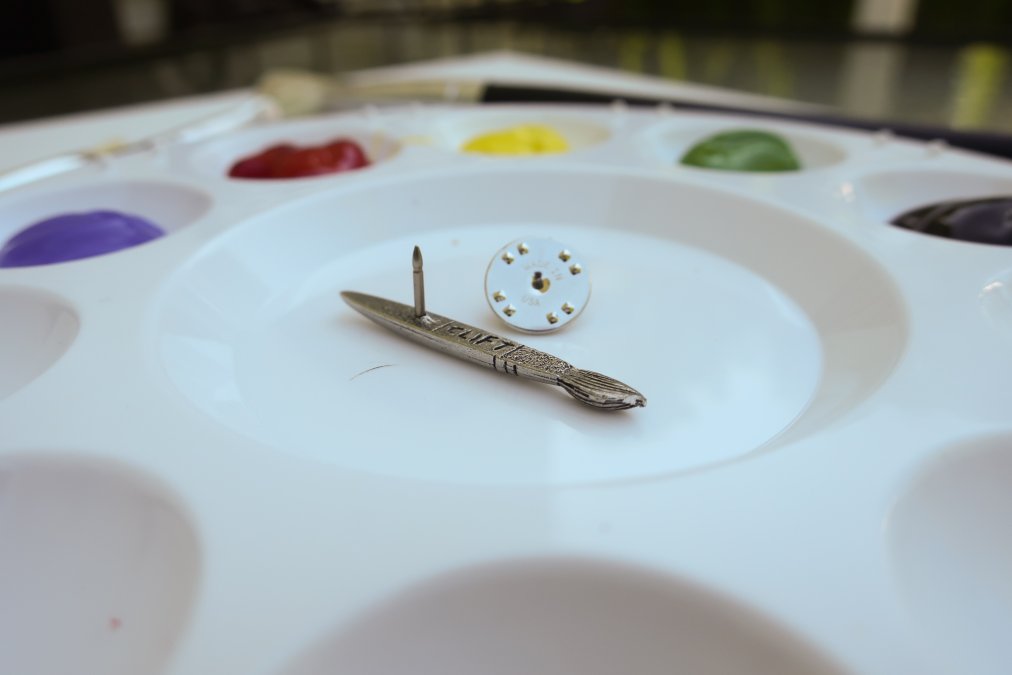
Close-up of the back of an art brush lapel pin with the military style clasp. The pin has the Clift signature and the clasp is made in the USA.
A final note on craftsmanship: the best clasp in the world cannot save a poorly designed pin. A pewter pin with a long, unsupported span, such as a banner hanging below the main body, will flex at the connection point every time it is handled. A quality maker thickens these load-bearing areas or adds a subtle structural rib on the back that is invisible when worn. This is the difference between a pin that survives a decade of weekly wear and one that develops a wobble after a few months.
The Verdict: Are Pewter Pins Right for Your Needs?
So, are pewter lapel pins durable enough for your collection, your uniform, or your next corporate event? For the vast majority of uses, the answer is a confident yes. A solid, lead-free pewter pin with a quality clasp will outlast the trend cycle, survive years of occasional wear, and still look presentable when you pass it down or add it to a shadow box. The material's natural resistance to corrosion and its forgiving malleability make it a smarter choice than brittle enamel or rust-prone base metals for a badge you actually intend to wear.
The caveat is that not all pewter pins are created equal. A mass-produced badge stamped from thin sheet metal will not perform like a hand-cast sculpture. If you are investing in a pin for a nonprofit fundraiser, a club insignia, or a personal collection, choose a maker who controls the alloy, casts each piece with care, and backs it with a secure clasp. At LapelPinPlanet, each pin is hand-cast in solid, lead-free fine pewter, signed by artist Jim Clift, and finished with the kind of detail that only comes from a family-run studio. Whether you need a single gift or a run of custom pins for your organization, the durability is built in from the first pour.
Frequently Asked Questions
Is pewter a durable metal for everyday wear?
Yes, modern fine pewter is durable for everyday wear. Unlike antique pewter, today's alloy is lead-free and primarily tin, making it resistant to corrosion and suitable for regular use. It's malleable, meaning it bends under stress rather than snapping. However, it's softer than steel or brass, so it can scratch if knocked against hard surfaces. For lapel pins, this durability is excellent, as they aren't subject to heavy impact. The main concern is the clasp, which is why high-quality pewter pins use military-style backs to ensure they stay secure.
How do you clean and maintain pewter lapel pins?
To clean pewter lapel pins, use warm water and mild dish soap. Dip a soft cloth in the solution, wring it out, and gently wipe the pin to remove oils and dirt. Dry it immediately with a clean, soft cloth to prevent water spots. Avoid harsh chemical cleaners and abrasive polishes, as they can scratch the soft metal and damage the finish. For stubborn grime, use a cotton swab dipped in soapy water. Regular gentle cleaning after heavy wear will keep the pin looking new without stripping its natural patina.
Is lead-free pewter safe for skin contact?
Yes, lead-free pewter is completely safe for skin contact. True fine pewter is composed mostly of tin, with small amounts of copper and antimony to harden it. Because it contains no lead, it won't leach harmful substances and is safe for everyday wear, even for those with sensitive skin. When shopping, always verify the pin is labeled lead-free. This standard ensures the pewter meets safety regulations for jewelry and confirms you are getting a quality product that won't cause skin irritation or pose health risks.
Does pewter tarnish over time?
Pewter is highly resistant to tarnish, unlike silver or copper. It doesn't oxidize in the same way, so it won't develop a dark, dull film. However, it can accumulate dirt, body oils, and dust, which makes the surface look dingy over time. This build-up is easily removed with mild soap and water to restore the original shine. While pewter develops a subtle, natural patina with age, this is a gentle dulling, not the corrosive tarnish seen on other base metals, and many collectors find it adds character.