


Custom Pins Orders: 2026 Guide
Table of Contents
- How Custom Pin Pricing Works at Small Quantities
- Custom Enamel Pins No Minimum: What to Expect
- Custom Pin Design Tips That Save Time and Money
- Turnaround Time for Custom Pins: A Realistic Timeline
- Sustainability and Material Sourcing for Custom Pins
- How to Order Custom Pins Online Without the Headaches
- Conclusion
Last Updated: August 27, 2026
How Custom Pin Pricing Works at Small Quantities
Manufacturers carry fixed costs that don't scale down with your order size. The smaller your batch, the more those fixed costs weigh on each individual unit. This is why bulk pricing exists and why per-unit cost drops sharply as quantities increase.
Order Quantity |
Per-Unit Cost Trend |
Setup Cost Impact |
Best For |
|---|---|---|---|
50-100 units |
Moderate |
Significant but manageable |
Small events, nonprofits |
250-500 units |
Lower |
Spread across more units |
Corporate programs |
500+ units |
Lowest per unit |
Minimal per unit |
Wholesale, large campaigns |
Mold Fees and Setup Costs Explained
A mold fee covers the creation of the physical die used to stamp or cast your pin design. Die-struck and die-cast pins require custom tooling for every new design. This one-time charge applies whether you order 50 pins or 1,000, making it a significant portion of total spend at low quantities.
Setup costs may cover artwork preparation, color matching, or screen setup for silkscreen printing. Some suppliers bundle these with the mold fee; others itemize them separately. Always request a full cost breakdown before approving an order.
Resale Profitability at Low Volumes
Artists and small brands ordering custom enamel pins to resell must understand their break-even point before placing an order. Calculate your total landed cost, unit price plus mold fee plus shipping, divided by pin count. That's your true cost per pin. Your retail price must cover this cost, marketplace fees, and still deliver a margin worth your time.
At very low quantities, resale profitability is often thin. Ordering 100 units instead of 50 may drop your per-unit cost enough to shift a marginal project into a genuinely profitable one.
Custom Enamel Pins No Minimum: What to Expect
Custom enamel pins with no minimum order requirements are widely available, but "no minimum" rarely means "no trade-offs." Most suppliers offering single-unit or very small batch production either use digital printing rather than traditional enamel manufacturing, or price fixed costs into a higher per-unit rate.
Soft Enamel vs. Hard Enamel for Small Batches
Soft enamel is the more common and affordable option. The enamel fill sits below the metal ridges, creating a textured surface. Colors are vivid and the process accommodates detailed designs well. Soft enamel pins are standard for promotional merchandise, event giveaways, and branded lapel pins. custom printing timelines.
Hard enamel involves a more labor-intensive process. The enamel is applied in layers and polished flat, creating a smooth, jewelry-grade surface. Hard enamel pins feel more substantial and hold up better over years of wear, but cost more per unit, a premium that compounds at small-batch quantities.
Die-Struck, Die-Cast, and Color Printed Options
Die-struck pins are stamped from a metal sheet using a custom die, resulting in a raised and recessed design with no enamel fill. They have a classic, understated look suited to professional settings.
Die-cast pins are made by injecting molten metal into a mold, allowing for three-dimensional complexity and sculptural detail.
Color printing applies color via UV printing onto a flat metal base. It's well-suited for photographic images or designs with gradients that enamel can't achieve, and generally costs less to set up than enamel pins for complex artwork.
Custom Pin Design Tips That Save Time and Money
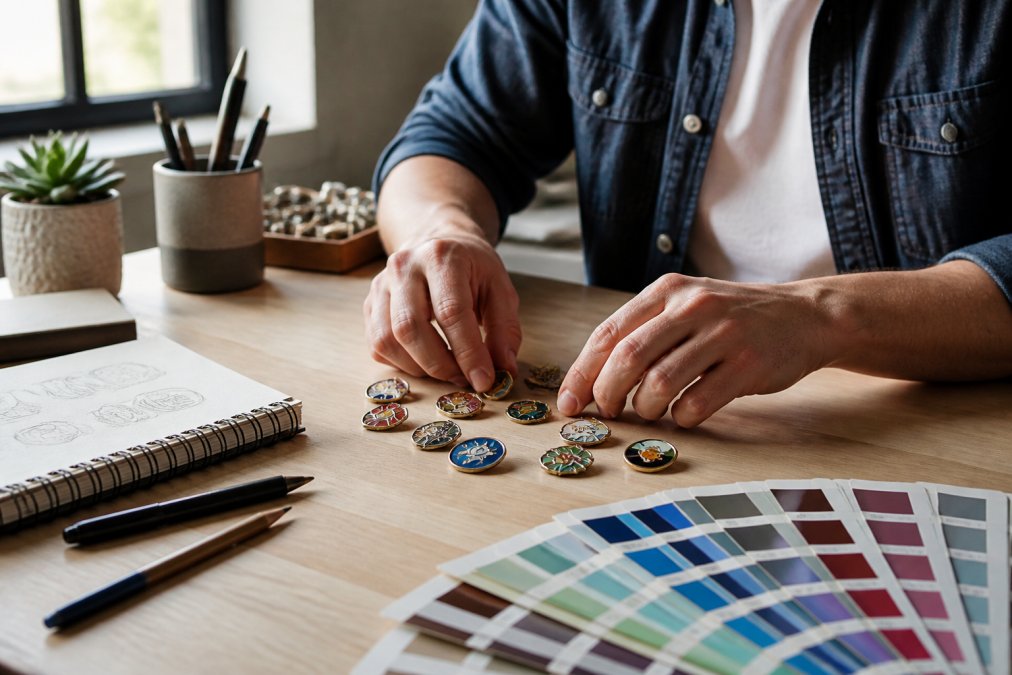
The biggest source of delays and unexpected costs isn't manufacturing, it's artwork. Suppliers who receive print-ready vector files with correctly specified Pantone colors move orders into production faster with fewer revision cycles.
Artwork Requirements: Vector Files and Pantone Colors
Vector artwork is non-negotiable for quality pin production. Vector files (AI, EPS, or SVG format) define shapes mathematically and scale to any size without losing sharpness (w3.org). Raster images (JPG, PNG, PSD) degrade when scaled to pin dimensions. Most suppliers offer artwork conversion services for a fee if you only have raster files.
Pantone color matching ensures enamel colors match your brand specification precisely. Pantone is a standardized color system manufacturers worldwide use as a common reference (pantone.com). Specifying "Pantone 286 C" ensures exact matching; specifying "bright blue" produces inconsistent results.
Choosing Plating, Finish, and Backing Options
Plating choices affect both look and perceived quality. Common options include gold plating, silver plating, antique gold, antique silver, black nickel, and rose gold. Gold reads as warmer and more traditional; nickel reads as cooler and more modern. Antique finishes add a recessed, aged look suited to heritage brands.
For pin backing, the standard clutch is a metal butterfly clutch.
Turnaround Time for Custom Pins: A Realistic Timeline
Turnaround depends on production method, order quantity, and proof approval speed. A realistic timeline for standard soft or hard enamel pins with print-ready artwork:
- Proof creation: 3-7 business days
- Proof approval: depends on your internal process
- Production: 10-15 business days after approval
- Shipping: 5-15 business days
Total elapsed time commonly runs 4 to 8 weeks. The proof approval step is where most orders stall. Organizations with multiple stakeholders can add weeks without any manufacturer delay. Work backward from your event deadline and build in buffer for internal approvals.
Die-struck and die-cast pins requiring new tooling add time for mold creation before production begins.
Sustainability and Material Sourcing for Custom Pins
Sustainability is an increasingly important consideration in pin manufacturing. Most standard lapel pins are made from zinc alloy, brass, or iron (peer-reviewed research). Environmental footprint depends on base metal, plating process, energy sources, and production waste handling.
Picture showing molten pewter being poured into the mold.
LapelPinPlanet hand-casts pins in solid, lead-free fine pewter using recycled materials and sustainable energy in family-crafted production. Every pin is signed by artist Jim Clift, offering genuine craft attention rather than mass-production indifference.
Ask any supplier directly: What is the base metal? Is it lead-free? What percentage of production waste is recycled? What energy sources power the facility?
How to Order Custom Pins Online Without the Headaches
Step 1: Define your design before contacting suppliers. Know your dimensions (most lapel pins range from 0.75 to 2 inches), color count, preferred enamel type, and intended backing.
Step 2: Prepare vector artwork with Pantone colors specified. Budget for artwork conversion if you only have raster files.
Step 3: Request quotes with a complete brief. Include quantity, dimensions, enamel type, plating preference, backing type, and target delivery date.
Step 4: Review the full cost breakdown. Ask for mold fees, setup costs, and shipping itemized separately. Compare total order costs, not per-unit prices alone.
Step 5: Approve your proof carefully. Check colors against Pantone specs, verify dimensions, and confirm text before signing off. Changes after production are expensive.
Step 6: Plan delivery timeline with buffer. Build in at least two weeks beyond the supplier's stated lead time for first orders.
A checklist for evaluating any custom pin supplier:
- Do they provide itemized quotes including mold fees and setup costs?
- Do they offer digital proofs before production?
- Is minimum order quantity stated clearly, or do they use minimum order values?
- Do they specify base metals and plating materials?
- What is their revision policy and are revision fees disclosed upfront?
- Can they provide samples in your chosen enamel type?
Step |
Action |
Common Pitfall |
|---|---|---|
Design prep |
Create vector files with Pantone colors |
Submitting raster images or unspecified colors |
Quoting |
Request full itemized breakdown |
Comparing unit prices without mold fees |
Proof review |
Check colors, dimensions, and text |
Approving too quickly without stakeholder sign-off |
Timeline |
Build in buffer beyond stated lead time |
Planning to the supplier's minimum, not your deadline |
Reorder planning |
Confirm mold storage terms |
Assuming your die is stored indefinitely at no cost |
Small-batch custom pin ordering rewards preparation. Buyers who arrive with vector artwork, Pantone specs, and a clear brief get faster quotes, fewer revisions, and more accurate pricing. The custom pin market has genuine options for low-minimum ordering. The best outcomes come from understanding what you're actually paying for.
LapelPinPlanet offers handcrafted, three-dimensional lapel pins cast in solid, lead-free fine pewter, with every piece signed by artist Jim Clift and produced through a sustainable, family-crafted process using recycled materials. For collectors, nonprofits, and organizations that want something more meaningful than standard promotional merchandise, our pins deliver craft and character that mass-produced options simply can't match. Submit your inquiry and let us help you find the right piece for your purpose.
Frequently Asked Questions
Q: Where can I order custom lapel pins with no minimum order quantity?
A: Several manufacturers and specialty retailers offer custom pins with no strict minimum order quantity, though 'no minimum' often comes with higher per-unit prices or mandatory setup fees that offset savings. For small organizations, nonprofits, or collectors needing custom pins, look for providers that are transparent about mold fees and unit pricing upfront. LapelPinPlanet caters to small-batch buyers and can walk you through options that fit a tighter budget.
Q: Are there quality differences between low-minimum and bulk custom pin orders?
A: The manufacturing process for soft enamel, hard enamel, or die-struck pins is the same whether you order 50 or 5,000 units. Quality differences come from the manufacturer's standards, not the quantity. What does change at low volumes is the cost per pin, since setup fees and mold fees are spread across fewer pieces. Choosing a maker with rigorous quality control and durable plating options ensures the finish holds regardless of batch size.
Q: What is the typical turnaround time for custom pins?
A: Turnaround time for custom pins varies by manufacturer, pin type, and design complexity. Standard production runs typically take two to four weeks after artwork approval, plus shipping time. Rush options can shorten this to one to two weeks but usually add cost. Die-struck pins and those requiring epoxy coating or specialty finishes may need extra time. Always confirm your deadline with the supplier before approving the prototype to avoid surprises.
Q: How do I keep custom pin design costs down when ordering a small batch?
A: Simplifying your design is the most direct way to reduce costs on a small batch order. Fewer Pantone colors, clean vector artwork submitted upfront, and avoiding complex cutouts all reduce production time and mold complexity. Choosing a standard pin backing like a butterfly clutch rather than specialty clutch types also helps. Providing print-ready vector files from the start eliminates revision rounds, which saves time and can reduce setup fees charged by the manufacturer.
This article was written using GrandRanker