


Custom Fundraising Pins for Nonprofits: 2026 Guide
Table of Contents
- Why Custom Fundraising Pins Work for Nonprofit Campaigns
- Charity Pin Design Ideas That Tell Your Mission Story
- Materials and Finishes: Pewter, Enamel, and More
- Custom Pins with Low Minimum Orders for Small Nonprofits
- How to Sell Custom Pins for Charity: Pricing, ROI, and Distribution
- Donor Recognition and Volunteer Appreciation with Pins
- Sustainable and Eco-Friendly Fundraising Pins
- Conclusion
- Frequently Asked Questions
Last Updated: September 10, 2026
Why Custom Fundraising Pins Work for Nonprofit Campaigns
Custom fundraising pins for nonprofits turn a small, wearable object into a year-round donor touchpoint.
Pins are low-cost per unit, easy to distribute, and impossible to ignore when worn. Unlike a flyer that ends up in recycling, a pin gets worn again and again, multiplying visibility far beyond its cost.
Here's what makes them effective:
- Tangible recognition that donors can keep and display
- Low unit cost that scales whether you order 50 or 500
- Versatility for events, volunteer appreciation, and membership drives
- Collectibility that encourages repeat engagement across campaigns
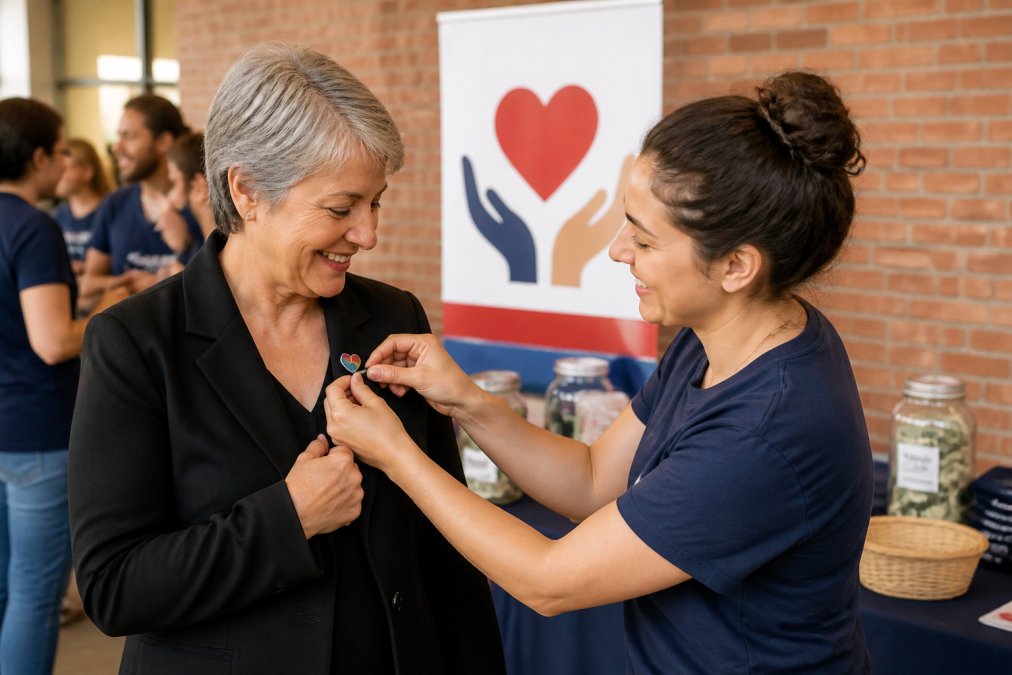
A nonprofit volunteer pinning a custom fundraising pin onto a donor's jacket at a charity event, with a banner and donation table in the background
Charity Pin Design Ideas That Tell Your Mission Story
Charity pin design ideas should start with your mission, not your logo. The strongest pins translate a core symbol, a service animal, a heart, a puzzle piece, a pair of hands, into a small three-dimensional form that reads clearly at a glance.
A common mistake is cramming too much text onto a pin; at thumbnail size, fine lettering disappears. Lead with one strong symbol, let color carry the meaning, and use Pantone matching to keep pins consistent with your branding across future orders.
Consider these directions:
- Symbol-first designs built around a single recognizable icon
- Membership pins that mark years of service or giving tiers
- Awareness campaign pins tied to a specific month or drive
- Commemorative pins for milestone anniversaries or capital campaigns
Materials and Finishes: Pewter, Enamel, and More
The material you choose decides how your pin feels, lasts, and photographs. Pewter, enamel, and button pins each serve different purposes, depending on your budget and how the pin will be worn.
Enamel pins are the most common for charity merchandise. Soft enamel leaves recessed color with a textured surface; hard enamel is polished flat for a smooth, high-gloss finish and resists scratching better, which matters if donors wear pins daily.
Metal badges cast in pewter offer a sculptural, three-dimensional look flat enamel can't match, and hold fine detail well, so even a small pin shows real depth.
Button pins are the cheapest option, but they dent easily and feel disposable. For donor recognition, they rarely carry the weight a cast metal pin does.
Material |
Look |
Durability |
Best For |
|---|---|---|---|
Soft enamel |
Textured, colorful |
Moderate |
Budget campaigns, large runs |
Hard enamel |
Smooth, glossy |
High |
Daily wear, premium gifts |
Cast pewter |
Sculptural, detailed |
High |
Commemorative, membership pins |
Button |
Flat, printed |
Low |
Quick awareness drives |
Custom Pins with Low Minimum Orders for Small Nonprofits
Small organizations often assume custom pins with low minimum orders don't exist, or that a short run carries a punishing premium. Not so, many producers price per unit rather than forcing a thousand-piece commitment. But "low minimum" means different things depending on the production method.

Unity Lapel Pin
Why Minimums Exist at All
Every pin order carries fixed costs that don't shrink with quantity: a die or mold must be cut, artwork separated into color layers, and the line set up before the first pin is struck. On a 1,000-piece run those costs nearly disappear; on a 50-piece run they land almost entirely on 50 units. That's why minimums exist, not vendor greed, but production physics.
Different methods carry different floors:
- Die-struck and cast metal pins require a cut die or mold, so minimums tend to be higher (often 50-100 pieces).
- Printed button pins need no die, so minimums can drop to 50 or even 25, but durability suffers, as noted in the materials section.
- Soft enamel typically has lower minimums than hard enamel because the polishing step is skipped.
The Real Cost Drivers on a Short Run
When you compare quotes for 50 pins, the per-unit price will look alarming next to a 500-piece quote. That's expected. Watch for whether the quote is honest about why:
- Setup or die fees, a one-time charge that should be stated separately, not buried in the unit price.
- Artwork and revision charges, some vendors include one round of revisions, others bill hourly.
- Color count, each additional enamel color adds a screen or a step; a four-color pin costs more to set up than a two-color pin.
- Plating, gold, silver, and antique finishes are priced differently.
- Packaging, individual poly bags are usually free; custom backing cards are not.
Ask for the all-in cost at 50, 100, and 250 pins. That three-point comparison reveals where the real price breaks sit and whether the minimum is a hard floor or a soft suggestion.
A Practical First-Order Playbook
For a small nonprofit testing pins for the first time:
- Order the smallest run the vendor allows, often 50, for a single upcoming event.
- Track two numbers: how many pins left the table, and how many of those recipients gave again within 90 days.
- If the repeat rate is strong, reorder at 250 or 500 for the next campaign, where per-unit cost drops meaningfully.
- If it isn't, you've spent a few hundred dollars to learn that pins aren't the right channel for that audience, far cheaper than a thousand-piece mistake.
What to Put in Writing Before You Order
A short email confirming these five points prevents most disputes:
- Exact quantity and per-unit price
- Setup and artwork fees, itemized
- Production and shipping timeline in business days
- Approval process (who signs off on the proof, and by when)
- What happens if the delivered pins don't match the approved proof
Low minimums are a genuine advantage for small organizations, but only when you understand the cost structure and plan the reorder before placing the first one.
How to Sell Custom Pins for Charity: Pricing, ROI, and Distribution
How to sell custom pins for charity comes down to three levers: a suggested donation that covers cost with margin, a clear return on investment, and a distribution plan that puts pins in the right hands. A fourth lever almost nobody writes about is how the pin affects the tax-deductible portion of a donor's gift.
Lever 1: Set the Suggested Donation
Start with your all-in cost per pin, production, setup amortized across the run, and shipping. If a pin costs a few dollars and you suggest a donation of two to three times that, the margin funds your programs. Run the numbers for your own run size rather than copying another organization's price.
Lever 2: Run the ROI Math Before You Order
Here's a simple ROI check. Fill in your own numbers:
Input |
Your Number |
|---|---|
All-in cost per pin |
$____ |
Suggested donation |
$____ |
Pins ordered |
____ |
Break-even pins distributed |
Total cost ÷ donation |
Projected surplus |
(Donation × pins distributed) − total cost |
Two refinements most nonprofits miss:
- Count the pin as a donor-acquisition cost, not just a merchandise cost. If a $5 pin brings in a first-time donor who gives $50 and then gives again next year, the pin's true ROI is measured over the donor's lifetime, not the single transaction.
- Separate "sold" from "given." Pins handed to volunteers or board members aren't revenue, they're retention spend. Track them in a separate column so your ROI math stays honest.
Lever 3: Distribution Logistics Decide the Outcome
Where and how pins reach people changes results more than the design does. Three common channels, with trade-offs:
At events (registration table or donation station). Highest conversion, because the pin is tied to a moment of giving. Hand the pin over after the donation, not before, it becomes a thank-you, not a freebie. Keep a tray visible so donors see others wearing them.
Direct mail. Lower conversion per piece, but reaches donors who don't attend events. A pin enclosed with an appeal letter lifts open-and-keep rates because it's a physical object in an envelope of paper. Budget for extra postage weight, a metal pin can push an envelope into a higher tier.
Online sales or fulfillment. Highest reach, lowest personal touch. Ship pins with a handwritten thank-you note; the note converts a one-time buyer into a repeat donor. Factor shipping into your per-unit math here, because it's the channel where it hurts most.
Lever 4: The Tax Question Nobody Asks
When a donor gives and receives a pin in return, the pin has value, and that value can reduce the tax-deductible portion of the gift. Under IRS rules, a donor may generally deduct only the amount of a contribution that exceeds the fair market value of any goods or services received. A pin given for a $25 gift is a small benefit; one given as part of a $500 membership tier is a larger one.
The IRS guidance on charitable contributions is the place to start, and the practical takeaway is this: if your organization provides pins in exchange for gifts, you may need to send donors a written disclosure stating the value of the pin and the deductible amount. Consult a qualified tax professional for your situation rather than assuming a pin counts as a de minimis benefit.
This matters for donor trust as much as compliance. A donor who learns at tax time that their "$100 donation" was only $95 deductible may not give again.
Donor Recognition and Volunteer Appreciation with Pins
A pin given at the right moment does more for donor engagement than a generic certificate. Volunteer appreciation and donor recognition hinge on making people feel seen, and a physical pin does that in a way an email never will.
The IRS guidance on charitable contributions is worth reviewing if you plan to tie pins to giving tiers, since acknowledgment rules and deductibility depend on the specifics of your campaign. Consult a qualified tax professional for your situation rather than assuming a pin counts as a deductible benefit.
Practical ways to use pins for recognition:
- Milestone pins for years of service or consecutive giving
- Tiered membership pins that mark giving levels
- Volunteer thank-you pins handed out at the close of each drive
- Board and staff pins to build internal community
LapelPinPlanet's Thank You Lapel Pin is designed exactly for this, a hand-cast pewter piece you can give to volunteers, staff, or neighbors who go above and beyond. For care-focused organizations, the Home - Heart - Hands Lapel Pin speaks to compassion and service.


Sustainable and Eco-Friendly Fundraising Pins
Eco-friendly fundraising pins are becoming a real differentiator as donors pay closer attention to how merchandise is made. Sustainability isn't just a talking point; it's part of the story donors want to support.
Look for producers who use recycled materials and sustainable energy. Cast metal pins can be made from recycled pewter, and a family-crafted process often means less waste.
Questions to ask a supplier:
- What percentage of the metal is recycled?
- Is production powered by renewable energy?
- Are the pins lead-free and safe for daily wear?
- Can packaging be recycled or made from recycled stock?
The FTC Green Guides set the standard for how environmental claims can be marketed, so keep your language accurate. Say "made with recycled materials" only when it's verifiably true.
Conclusion
Choosing the right pins means balancing design, material, cost, and distribution. Get that balance right, and a single pin can carry your mission for years.
LapelPinPlanet can help. Our pins are hand-cast in solid, lead-free fine pewter, each an original three-dimensional sculpture signed by artist Jim Clift. We use recycled materials and sustainable energy in production, and we price for small nonprofits ordering low minimums.
Submit your artwork and get a quote for your next fundraiser.
Frequently Asked Questions
How much does it cost to produce custom fundraising pins for a nonprofit fundraiser?
Costs vary by design, material, and quantity. At LapelPinPlanet, hand-cast pewter pins start at $11 each, with discounts for bulk orders. For a 100-pin run, expect around $1,100 before any nonprofit discount. Soft enamel pins often cost less per unit but may lack the three-dimensional detail of pewter. Always request a quote and ask about nonprofit pricing.
What are the best design practices for charity lapel pins?
Keep it simple and symbolic. Use 2-3 colors, avoid tiny text, and incorporate your logo or mission icon. For pewter pins, three-dimensional sculpting works well. For enamel, bold outlines and Pantone color matching ensure consistency. Always request a digital proof before production to catch issues early.
How do custom pins help increase nonprofit donations?
Pins serve as tangible tokens of appreciation that donors can wear, increasing brand visibility and emotional connection. They work as donor incentives at giving levels, volunteer rewards, and merchandise sold at events. By attaching pins to donation tiers, nonprofits often see higher average gifts and improved donor retention.
What is the typical turnaround time for custom nonprofit pins?
Production timelines depend on the supplier and complexity. For hand-cast pewter pins, expect 2-4 weeks after artwork approval. Enamel pins may take 3-6 weeks. Always factor in shipping time. Rush options may be available for an extra fee, so plan ahead for fundraising events.
Can we order custom pins with low minimum orders for our small nonprofit?
Yes, many suppliers cater to small nonprofits. LapelPinPlanet offers low minimums, often as few as 25 pins, making it feasible for tight budgets. This allows you to test designs or order limited runs for special events without overcommitting. Always ask about minimums and setup fees upfront.
Are custom fundraising pins tax-deductible for donors?
In the U.S., if a donor receives a pin in exchange for a donation, the fair market value of the pin must be subtracted from the deductible amount. For example, a $50 donation with a $10 pin yields a $40 tax deduction. Nonprofits should provide donors with a receipt stating the deductible portion. Consult a tax advisor for specifics.