


Artistic Lapel Pins for Professional Attire: 2026 Guide
Table of Contents
- Why Artistic Lapel Pins Belong in Professional Attire
- How to Style Lapel Pins for Work: Placement and Pairing
- Color Theory and Suit Coordination for Artistic Pins
- Professional Etiquette for Workplace Pins
- Meaningful Corporate Gifts for Employees: Selecting Artistic Pins
- Custom Lapel Pins for Branding: Design and Ordering
- Caring for Your Artistic Lapel Pins
- Conclusion
- Frequently Asked Questions
Last Updated: September 13, 2026
Why Artistic Lapel Pins Belong in Professional Attire
Artistic lapel pins for professional attire turn a plain suit lapel into a signature, signaling identity, affiliation, and taste without a word. This guide from LapelPinPlanet covers styling, placement, etiquette, and how to choose pieces worth wearing.
The best artistic lapel pins for professional attire share three traits: subtle size, a finish that lasts, and relevance to the wearer. A handcrafted pin in solid, lead-free pewter reads as considered; a cheap die-struck pin with flaking plating reads as an afterthought.
Most guides treat pins as pure decoration. In business formal settings, a pin is a communication device that tells clients, colleagues, and interviewers who you are before you speak. Choose accordingly.
How to Style Lapel Pins for Work: Placement and Pairing
How to style lapel pins for work comes down to two decisions: where the pin sits and what it sits next to. Get placement right and the pin looks intentional; get pairing right and it looks like it belongs. Most guides stop at "wear it on your left lapel" and never explain the mechanics that keep a jacket from being damaged or a pin from sitting crooked.
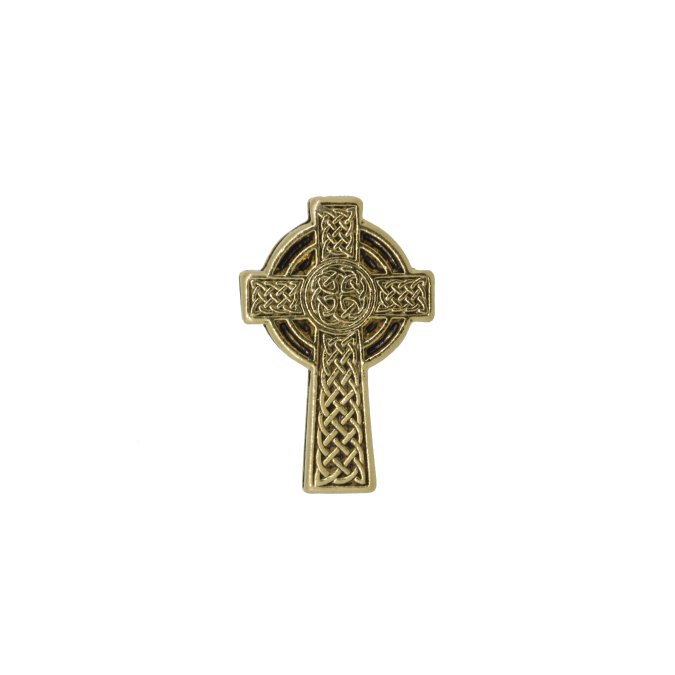
Gold Celtic Cross Lapel Pin
Pairing rules are simple. Match metal finish to your other hardware: silver-toned pewter with a silver watch and gray or blue suiting, gold-dipped pins with warmer tones and brown leather. Keep one pin per lapel. If you wear a tie tack or a buttonhole flower, the pin should be the only metal feature above the breast pocket.
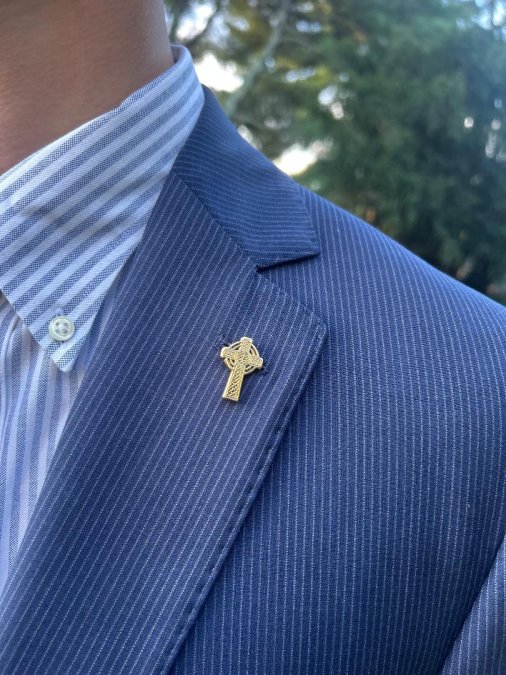
Close-up of a blue sports coat with a gold dipped pewter Celtic cross lapel pin on the left lapel of a navy suit jacket, with a white and blue striped shirt visible in the background
Pin Placement Mechanics
Placement depends on whether your jacket has a functioning buttonhole. Most off-the-rack jackets have a decorative buttonhole stitched closed on the left lapel; higher-end and made-to-measure pieces have one that opens. Knowing which you own determines how you attach the pin and whether you risk damaging the fabric.
On a jacket with a functioning buttonhole: The pin sits through the buttonhole opening on the left lapel, roughly 2.5 to 4 centimeters below the collar notch. Thread the post through from the front, then secure the clasp behind the lapel. This is safest because the pin passes through an existing opening rather than piercing fabric, and the buttonhole holds it upright so it will not rotate or sag.
On a jacket with a decorative (stitched-closed) buttonhole: Pin through the lapel fabric, angled slightly upward so the clasp hides behind the lapel, or, as most tailors recommend for expensive suiting, have a tailor open the buttonhole so you can use the buttonhole method. Opening a buttonhole costs far less than repairing a stretched pin hole in a wool lapel.
On a jacket with no buttonhole at all: Pin through the lapel fabric with a thinner post. A thick post on lightweight wool or linen leaves a visible hole, and daily wear makes it permanent. Rotate the pin's position by a few millimeters every few weeks to avoid wearing a single spot.
Three placement rules worth memorizing:
- Left lapel only for personal pins; right lapel is reserved for formal decorations and awards
- Keep the pin at least 2 centimeters clear of the collar notch
- The pin's top edge should sit no higher than the midpoint of the lapel
Clutch back and military-style clasp backs hold more securely than butterfly backs on heavier suit fabric. Test the clasp before you leave the house; a pin that rotates 90 degrees by lunchtime was not secured properly.
Lapel Width and Pin Scale
Lapel width has narrowed over two decades: a 1990s jacket may have a 9 to 10 centimeter lapel, while a contemporary slim-cut jacket measures 6 to 7. As a working rule, the pin's width should not exceed one-third of the visible lapel width, about 2 centimeters on a 6-centimeter lapel, while a 3-centimeter pin still reads as restrained on a 9-centimeter one.
This is why the same pin can look right on one jacket and wrong on another. Before buying, measure the lapel on the jacket you wear most and hold the pin against it; if it covers more than a third of the width, size down.
Color Theory and Suit Coordination for Artistic Pins
Color theory is where artistic pins separate from generic badges. The fastest rule: contrast the pin against the suit, not the shirt. A silver-toned pewter pin disappears on light gray but pops immediately on navy or charcoal.
But contrast alone is not enough. The pin's finish, not just its color, determines whether it reads as integrated or accidental. The layer most guides miss is matching metal finish to fabric color and texture, which separates a pin that looks chosen from one that looks borrowed.
Matching Metal Finish to Suit Fabric
Metal finish falls into three broad families: silver-toned (pewter, sterling, chrome, stainless), gold-toned (yellow gold, brass, gold-dipped), and rose gold or copper-toned. Each family interacts differently with suit colors and fabric textures.
Silver-toned finishes pair most cleanly with cool suit colors: navy, charcoal, slate gray, and true black. On mid-gray or light gray, a silver pin washes out because the values are too close; on navy or charcoal it reads as crisp and deliberate. Silver also holds up against textured fabrics like flannel and birdseye, letting the texture show through.
Gold-toned finishes pair with warm suit colors: brown, olive, tan, camel, and warm charcoal. Gold on navy is a classic high-contrast combination that works in business formal settings because the contrast is traditional rather than trendy. Gold on black reads more evening than office, and gold on gray is trickiest, muddy on cool grays, rich on warm grays, so test it under office lighting first.
Rose gold and copper-toned finishes sit between silver and gold and pair well with earth tones, burgundy, deep green, and warm browns. Rose gold on navy is a softer, more contemporary alternative to yellow gold; on charcoal it can look muddy because both tones are muted, so reserve it for suits with warmer undertones.
Fabric Texture Changes the Calculation
Suit fabric is not a flat color. Wool, flannel, tweed, linen, and worsted wool each absorb and reflect light differently, changing how a metal finish reads.
- Smooth worsted wool reflects light evenly, so a polished or shiny pin finish stands out sharply. This is where a high-polish gold or silver pin looks most formal.
- Flannel and brushed wool absorb light, so a shiny pin can look out of place. A matte or antiqued finish, common in handcrafted pewter, integrates better.
- Tweed and heavily textured wool already carry visual noise. A simple, single-color pin in a matte finish reads as considered; a detailed or multi-color pin competes with the fabric and looks busy.
- Linen and cotton suiting are casual by nature, so a matte or antiqued finish fits better than a high-polish one.
This is why two pins of the same color can look completely different on two jackets: the finish and fabric do as much work as the color.
Working the Color Wheel
Work the color wheel in one of two directions. Analogous coordination pairs the pin with neighboring suit tones: a warm gold pin on brown or olive suiting, a cool pewter pin on blue or gray. Complementary coordination uses one deliberate clash: a warm-toned pin on a cool suit, which draws the eye exactly where you want it.
A third option is tonal coordination: a pin in the same color family as the suit but a different value. A deep navy suit with a lighter blue enamel pin reads as sophisticated and low-risk, making tonal coordination the safest choice for business formal environments where contrast can read as flashy.
A Quick Reference for Common Suit Colors
- Navy: silver, gold, rose gold, and most enamel colors work. Navy is the most forgiving suit color for pins.
- Charcoal: silver and rose gold work; yellow gold can look muddy. Avoid pins with gray or muted tones that blend in.
- Black: gold and silver both work; rose gold reads softer. Black is the most formal and pairs best with a single, simple pin.
- Brown: gold and rose gold work; silver can look cold. Warm enamel colors like amber or rust integrate well.
- Olive: gold and rose gold work; silver can look military. Earth-tone enamels are the safest choice.
- Light gray: darker pins work; light silver or pale gold can wash out. Contrast is essential here.
If you wear one suit most of the time, buy the pin that works with it first. If you rotate through several, a silver-toned or pewter pin is the most versatile choice, working across navy, charcoal, and black.
Professional Etiquette for Workplace Pins
Workplace pin etiquette follows the same logic as any dress code item: the pin should never be the loudest thing in the room. In business formal environments, one pin is standard; two reads as a collection, three as a costume.
Match the pin's message to the setting. Industry conference: a personal interest pin is fine. Client meeting: a company or cause pin works. Job interview: keep it minimal or skip it entirely, since you cannot yet read the room's culture.
Many corporate dress codes do not mention pins at all, so the default is "professional and unobtrusive." If your handbook is silent, ask your manager rather than assume, a five-second question beats a written warning.
Meaningful Corporate Gifts for Employees: Selecting Artistic Pins
Meaningful corporate gifts for employees carry a specific, personal signal. A generic branded pen gets left in a drawer; a pin that references the recipient's role, hobby, or milestone gets worn.
Selection criteria that separate a good gift from a forgettable one:
- Relevance: the pin should connect to the person, not just the company
- Quality: handcrafted pieces in solid metal outlast printed pins that can fade
- Presentation: a pin arriving on a presentation card is ready to give; a pin in a plastic bag is not
LapelPinPlanet's art-themed pins, including the Art Palette Lapel Pin at $11.00 and the Art Brush Lapel Pin at $11.00, suit recognition gifts for creative teams, art departments, and design staff. Each is hand cast in solid, lead-free pewter and arrives on a signature presentation card.

A common mistake is ordering one generic design for an entire team. The pins people actually wear are the ones that feel chosen for them.
Custom Lapel Pins for Branding: Design and Ordering
Custom lapel pins for branding turn a logo into something people choose to wear. The design constraint is scale: at roughly 2 to 3 centimeters across, fine detail disappears, so bold shapes and clean silhouettes survive while complex crests do not.
For custom orders, a short revision cycle and a clear proofing step matter.
Caring for Your Artistic Lapel Pins
Care for a pewter or plated metal pin with a soft cloth and nothing abrasive, wiping the surface after wearing to remove skin oils that dull the finish. Store pins dry, ideally on their presentation card or in a lined box, so metal does not rub against other pins and scratch.
Three habits that extend a pin's life:
- Fasten and unfasten the clasp by the clasp, never by pulling the pin face
- Keep pins away from perfume, hairspray, and cleaning solvents
- Inspect the clasp every few months and replace a loose back before you lose the pin
A handcrafted pin in solid pewter, like the pieces LapelPinPlanet casts and finishes, holds up far better than die cast costume pins. The finish is the metal, not a coating, so there is nothing to wear through.
Conclusion
The challenge with artistic lapel pins for professional attire is not finding a pin, but finding one that holds its finish, fits your suit's palette, and means something to the wearer. LapelPinPlanet hand casts each piece in solid, lead-free pewter, signs the original sculptures, and packages every pin on a presentation card ready for gifting. Explore the full collection and find a pin worth wearing every day.
Frequently Asked Questions
What is the rule for wearing lapel pins on professional suits?
Wear a single lapel pin on the left lapel, positioned just above the buttonhole. Keep the pin small to medium in size, and ensure it matches the formality of your suit. Avoid multiple pins unless they are part of a recognized set. For business formal, choose subtle designs; for business casual, you can experiment with artistic pieces. Always secure the pin with a clutch back or tie tack to prevent movement.
How do you choose an artistic lapel pin that remains professional?
Select pins with a clean, recognizable motif and a polished finish. Avoid overly large or flashy designs. Consider the setting: a handcrafted pewter pin with a classic theme like an artist's palette or musical instrument works well in creative fields, while a gold-dipped pin adds formality. Match the pin's color to your suit's metal accents (e.g., gold with gold buttons). Ensure the pin lies flat and doesn't snag fabric.
Are lapel pins appropriate for formal business settings?
Yes, lapel pins are appropriate when chosen with restraint. Stick to one pin on the left lapel, keep it under 2 inches, and opt for subdued colors. In conservative industries, a simple metal or enamel pin in a classic shape (e.g., flag, logo) is safe. For creative industries, artistic pins can express personality. Avoid novelty or oversized pins. When in doubt, follow company dress code or observe what senior colleagues wear.
How can lapel pins be used as meaningful corporate gifts for employees?
Lapel pins make meaningful corporate gifts because they recognize milestones, achievements, or brand affiliation. Choose a design that reflects the employee's role or the company's values. For example, a handcrafted pin with a custom card can be given for years of service. They are affordable, portable, and wearable daily. To increase impact, pair the pin with a personal note and present it during a team meeting or ceremony.